In December 2013, the Shenzhen Design Center launched a small design competition titled ’10x10x100′ that focused on new approaches to density in urban development and the way architects approach FAR (Floor Area Ratio) parameters. As my exclusive project on behalf of FCHA, I sought to offer a comprehensive design response to floor-area ratio and density issues. A variety of social and environmental issues were considered: I determined that housing typologies should be tailored to suit both residents who must commute long distances and those who do not. Transportation and circulation should move beyond the conventional duality of elevators for vertical circulation, and ground-level plazas and sidewalks for horizontal circulation. Perhaps most urgently, the issue of resource-use should be addressed by considering the bio-footprint of large developments. In Shenzhen, the average resident has a bio-footprint that is 47 times the size of the city’s bio-capacity!
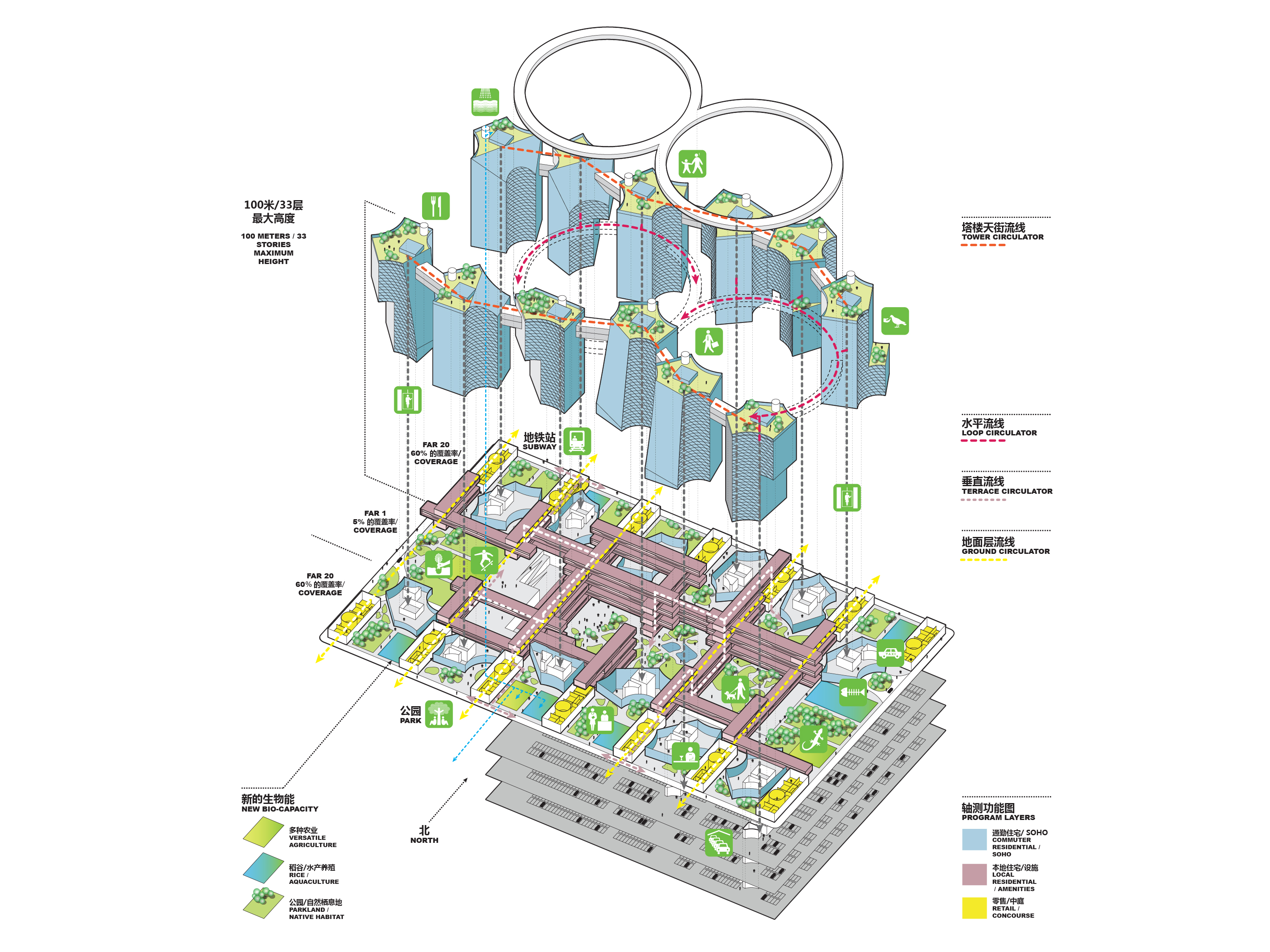
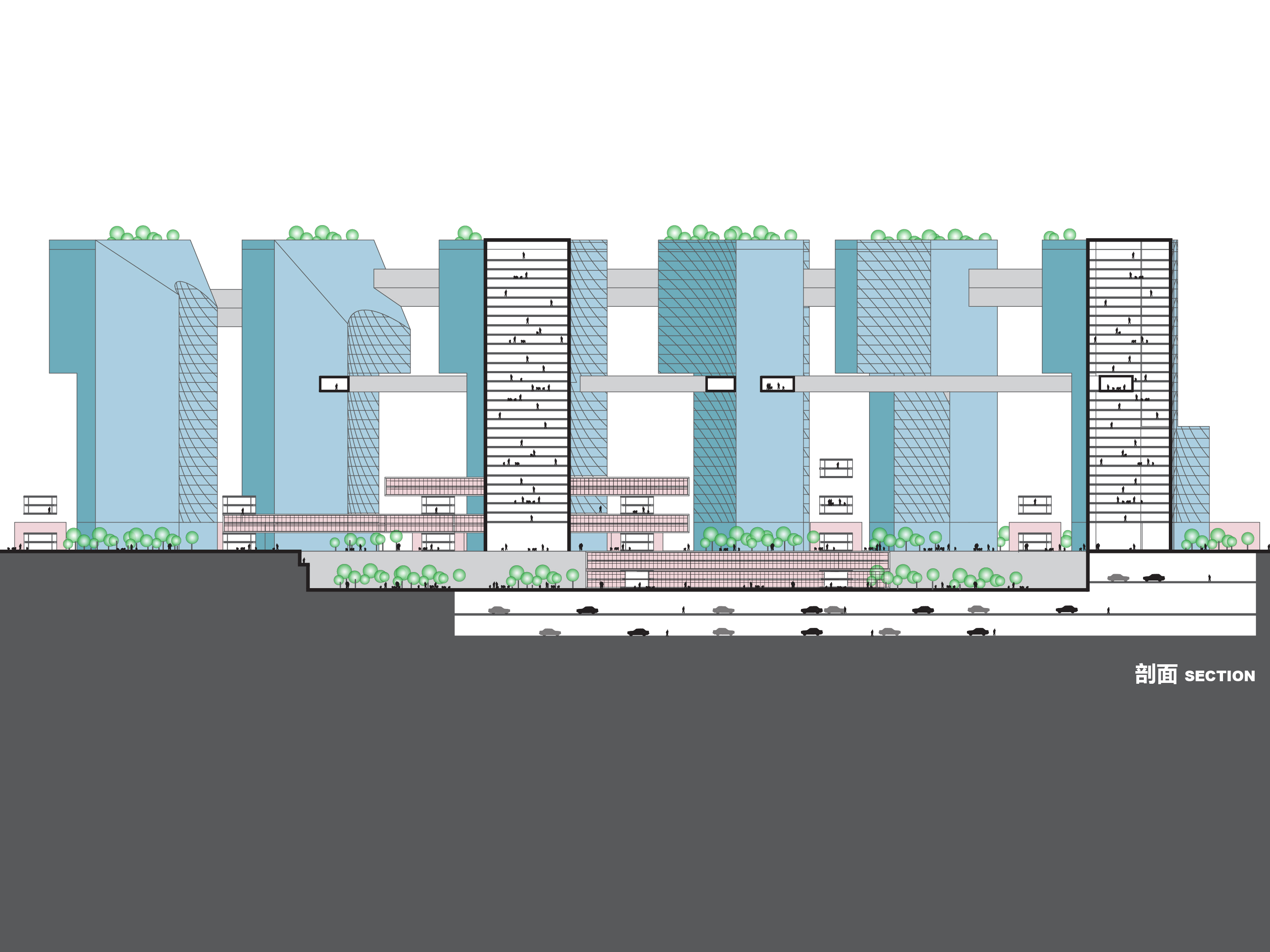
The proposal calls for a layered approach to the modern challenges of density. To accommodate a floor to area ratio of 1:10 on a 10 hectare site with a height limit of 100 meters, the site is divided into three sections at ground level. The north and south are best suited for the highest levels of density on the site because they face a subway station and public park, respectively. They are given an FAR of 1:20 with 60% maximum site coverage. The middle portion of the site is set aside for open space with an FAR of 1:1 with only 5% maximum site coverage. Long, terraced low-rise buildings frame the central plaza and provide homes for people who work locally as well as other amenities. Towers rise from the dense edges of site and house apartments and soho offices for people who need to commute some distance to work.
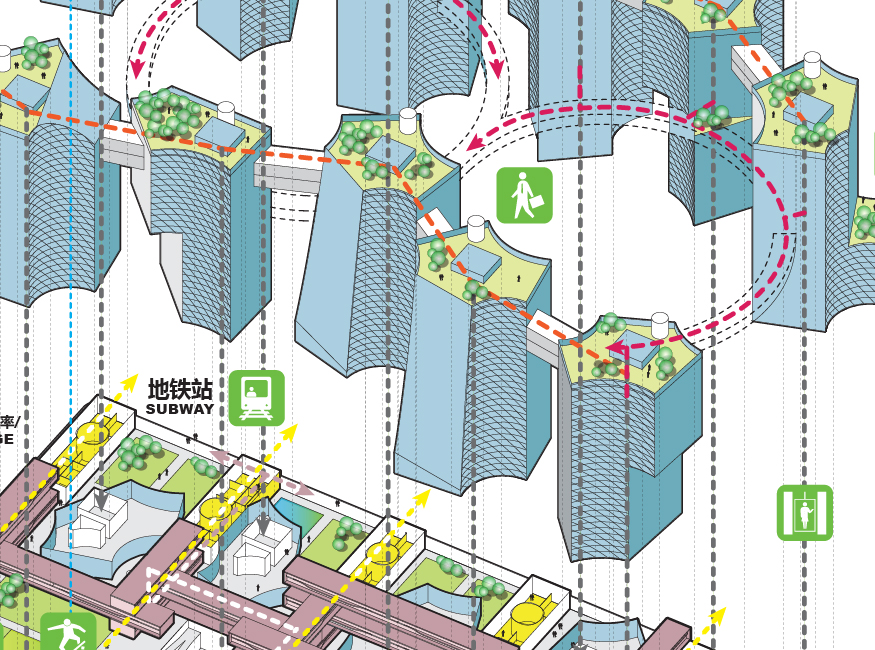
Circulation across and throughout the site is neatly organized into four layers: a ground level network of sidewalks, plazas, and other circulation paths with easy access for cyclists and pedestrians (free from car traffic), and three more levels arranged vertically. The second is the terrace-level circulator which connects the terrace level apartments and shops with the lower level of the towers and the sunken plaza. The third is a double-loop interior circulation path that allows for easy connectivity between the mid-levels of the towers (ideal during hot summers and bad weather). The fourth is a circulation path between the towers at the upper levels to allow access to green spaces and top-floor restaurants.
The entire scheme functions as a series of layered interactions. Interaction between residents and visitors is encouraged by a layered circulation system that no longer restricts social interaction to the ground outside of towers that only residents can enter by elevator. Interaction with resources is fostered by devoting most open space on the ground and on top of buildings to new bio-capcity (both native plants and small-scale agriculture). These systems are made possible by dividing a site’s far into zones which can best support the programs being constructed. A more thoughtful system of employing FAR and integrated systems can be an effective new typology of density in urban development.

 MATTHEW MARANO